Celebrating the Birthdate of Legendary Coach Erk Russell
7/23/2014 1:25:00 PM | Football
"Father of Georgia Southern Football" born in Birmingham, Alabama, today in 1926
 |  |
It was spring, 1981, and the bald-headed driver pulled his vehicle over on the side of the road to a pay phone to place a call to Georgia Southern President Dale Lick. Coach Erskine "Erk" Russell had been contemplating his future and an offer to resurrect the institution's football program as its new head coach.
Just a few months before, he stood on the sidelines of the Sugar Bowl, celebrating the University of Georgia's national championship victory over Notre Dame. The mastermind behind UGA's "Junkyard Dawgs" and a master motivator, Russell had been in Athens with Vince Dooley since 1963. It was time for a new challenge.
A former teachers' college, Georgia Southern was planning on fielding its first football team in more than four decades. Minutes before Erk was introduced to the press and the fans in the gymnasium, the school without so much as a tackling dummy, pads or even enough grass for a practice field, sent someone to the K-Mart across the street to buy a football.
One hundred and thirty-four "enthusiastic non-athletes" turned out for football tryouts on the campus tennis courts, ready to represent Georgia Southern, ready to play for Erk. "All they had was desire," Russell commented, finding something positive in any and all situations. "When you don't have the best of everything, make the best of everything you have," Russell often said.
With a makeshift coaching staff, a mobile home for an office and equipment scavenged from nearby schools, Georgia Southern started football practice. Its first scrimmage was just five months after Russell was named head coach, with players in mismatched helmets and jerseys and hand-me-down pads. Playing the first two seasons as a club team, the Eagles matched up against the Florida State junior varsity, the Fort Benning Doughboys and a semi-pro team of police officers from Jacksonville, Fla. Georgia Southern would take to highways to play against anyone, anywhere.
Russell would have not only have to build the program, he'd have to build support for program. A gift for storytelling, he'd create traditions and sayings, (GATA, Runts have to Try Harder), building young men into champions and building a football stadium on a piece of land where weeds towered above the heads of his players. Russell would spend many more nights driving the back roads of South Georgia, recruiting athletes overlooked by the powerhouse programs and selling a vision of Eagle Football to anyone who would listen.
Everyone owned a part of this team. A sawbuck bought several pairs of socks or workout shorts, a ten or twenty was put toward scholarships. The Bulloch County School Board sold the college two old yellow school buses for a dollar each so the team could travel to games. Leaders in the community and the region had committed the assistance to build a stadium and locker room for the team. In 1984, the Eagles played their first season at the NCAA level, dedicated Paulson Stadium and ran off a string of five straight wins and catapulted to seventh in the national rankings. Two untimely losses bumped Georgia Southern out of the polls and out of contention for the playoffs.
The season was recounted in detail at Snooky's, home of "America's worst coffee and some of the best people (Erk) had ever been around." Georgia Southern, a team in existence for only four years, had something to prove in 1985. Erk's Eagles would play his brand of hard-nosed football and win nine games against only two losses. After Georgia Southern pounded Jackson State in the first round of the playoffs, Russell and his team wanted to play "just one more time." The Eagles would face off against the number-one team in the nation, the Blue Raiders of Middle Tennessee State, who had handed Georgia Southern its only home field loss earlier in the season. Georgia Southern was eager to return the favor. The upset sent the Eagles to Northern Iowa, the farthest away they had ever traveled.
Even "a million miles from home," Russell had brought some of Statesboro to the frozen plains of the Midwest – sprinkling "the magical waters" of Eagle Creek on the Astroturf endzones. Georgia Southern held onto the win over Northern Iowa and would play against Furman in the national championship game in Tacoma, Wash. Trailing Furman 21-6 after the first half, Erk didn't panic. During halftime, he outlined for his team the plan to get back into the game. In the final play of the game, quarterback Tracy Ham threw a bullet of a pass into the outstretched arms of Frankie Johnson to win the college's first NCAA national title. Thousands of fans met the team at the Savannah Airport, another four or five thousand were waiting inside Hanner Fieldhouse for their champions to arrive home.
Some of the first players who joined Russell in the early years were now in their senior seasons. Despite two bitter losses, the Eagles earned a berth in the playoffs. Home field advantage through the first two rounds set the stage for another stunning Georgia Southern road victory. The Eagles upset top-ranked Nevada Reno on its home field, then traveled back to Tacoma to defeat Arkansas State. Russell had guided Georgia Southern to the first back-to-back championships in I-AA history.
Many programs would relish a 9-4 season, but for Georgia Southern, 1987 was labeled a rebuilding year. The college, however, riding on the attention generated by the recent success of the football program, was named the "fastest growing college in America" by a national magazine. Enrollment doubled and the institution grew in both size and reputation.
Russell surrounded himself with people who believed in the hard work and dedication it took to win, who believed that the best course of action was to "Do Right" and who believed in Georgia Southern. After a 3-0 start, the Eagles lost two straight on the road, allowing Middle Tennessee State a much-needed win and letting Florida State snatch away a third-quarter lead. Georgia Southern would regain its form, rattling off eight straight wins before a defensive showdown with Furman for the title. When it was announced that Georgia's Dooley would step down as football coach, Russell, the disciplinarian who led by example, was asked to take the job. Speculation swirled in the newspapers, in the halls of the Capital, in the barbershops and around the water coolers of Georgia. The Eagles returned to Statesboro as national runners up; Russell decided to stay in Statesboro and Georgia denied the offer.
The disappointment of the loss in the 1988 championship game still sharp in his memory, Russell reminded his team not to look past any opponent and take one game at a time, The Eagles rolled to victory in its first three games, outscoring opponents 107-17. The next home game, Georgia Southern would play host to one of the first Thursday night games televised on national sports network ESPN. Fans headed to the stadium to witness the arrival of the temporary lights, but no one was sure the game would actually be played.
Sweeping through the Carribean, Hurricane Hugo was aiming for Southeast Georgia and forced the evacuation of Savannah the week of the game. The eye of the category-four storm would make landfall that night in nearby Charleston, S.C. A direct connection between the college's geology professors in the pressbox and the National Hurricane Center updated weather reports to officials as torrential wind and rain pounded the area. Georgia Southern won the "Hugo Bowl" in front of the national audience, then dominated its next 10 games to secure another championship game appearance.
This time, however, the Eagles would not have to travel cross country; Statesboro had been selected as the host site for the championship game. The yellow school buses, rocking with testosterone, pulled up in front of the fans at Paulson Stadium. Fans in every corner of the stadium, on the hillsides and in temporary seating watched a back-and-forth battle. After taking an early lead, Stephen F. Austin held Georgia Southern scoreless in the third quarter and the Jacks pulled to a slim 27-20 margin. Sending "E.T. over the Top," the Eagles tied the game, then kicked a field goal to win a third national championship in five years. Russell was carried around the field on his players' shoulders as fans surrounded him, celebrating the title and historic, perfect 15-0 season.
Coach Russell inspired and touched thousands with his humor, and no-nonsense approach. Russell earned numerous coaching accolades during his eight-year head coaching career, including USA Today's Coach of the Decade for the 1980s and posted an 83-22-1 record for a winning percentage of .788. The morning after speaking to the 2006 Eagle team, Russell passed away. His memory has been honored by Georgia Southern University (the naming of Erk Russell Athletic Park and retiring of his name at the stadium), the community ("Game Day" bust of Russell overlooking the football field) and state of Georgia (Erk Russell Highway).
On the occasion of his retirement, at a dinner held in his honor, Erk
closed with these remarks:
"I am going to get out of here while I am still alive,
I'm going to say it one more time:
We're Georgia Southern.
Our colors are blue and white.
We call ourselves the Bald Eagles.
We call our offense the Georgia Power Company,
that is a terrific name for an offense
and our snap count is "Rate Hike."
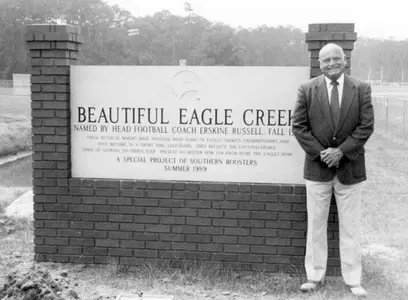
We practice on the banks of beautiful Eagle Creek
and that's in Statesboro, Georgia,
the gnat capital of America.
Our weekends begin on Thursday.
The coeds outnumber the men three to two.
They are all good lookin' and they are all rich.
And folks, you can't beat that,
and you just can't beat Georgia Southern.
And you ain't seen nothin' yet."

Friday, August 07
Thursday, August 06
Wednesday, August 05
Wednesday, August 05